Showing posts with label dinosauroids. Show all posts

Monday, November 14, 2011

Anthroposaurus sapiens

Dale Russell's dinosauroid was so controversial in part because it was the first time a respected man of science designed a model for speculative dinosaur evolution. The sort of backlash he endured from his own peers ensured that subsequent attempts at such speculation were abandoned from fear, and left solely to the sci-fi writer and the more adventurous paleo-artist. Mike Magee, however, in his book Who Lies Sleeping? The dinosaur heritage and the extinction of man, has no reservations about speculating about the existence of a sentient dinosaur, in fact he insists they did exist, and that they ultimately destroyed themselves much in the same fashion that mankind ultimately will.

Naturally, several times throughout the book, I had to stop and really think, "is this guy for real?" And in the 'About the Author' section we find that Magee "attempts to dull his fervid imagination with the local cider, and though he quite often succeeds, he does not blame it for this book". So, naturally, I instantly warmed up to the man. The book is never tongue-in-cheek, but is clearly the product of a rational and thoughtful man from Leeds, who just so happens to think dinosaurs developed nuclear power.

The arguments in the book are often informed and reasonable, and were obviously researched a great deal. That is not to say that the conclusions are not stretched and sensational, but Magee makes a sensational argument near-plausible, without ever crossing into sheer raving lunacy. The result is a fascinating and awesome read.

I have to admit, I don't really care for the humans are destroying themselves motif at this point; I am just sort of bored with humans. And the parts about the dinosauroid psyche echoing in our subconscious, I just rifled right through those. So it's possible I'm giving the other too much credit. But I was mainly looking to jump right ahead to the Anthroposaurs, so I warp zoned all the way to Chapter 9, the one titled "Anthroposaurus Sapiens". This is the point when Magee really gets down to business; Second sentence, second paragraph:
Some dinosaurs did develop intelligence and by doing so caused the Cretaceous terminal extinction.
Boom. Yup. No messin' around. What follows comes the a series of explanations for the evolution of such a dinosaur that, more often than not, are based on the fact that they can not be proven otherwise.

He starts by saying that when we look back on dinosaurs (and I believe he's mainly dealing with deinonychosauridae here), brain:body ratio as an indicator of intelligence may not be all that it's cracked up to be. And that in dinosaurs, "a higher metabolic rate, more active brains, faster synapses, sharper nerve impulses, could all contribute to greater efficiency of the brain even though it were smaller than ours". He says perhaps dinosaur brains did not have the "redundant memory capacity" that humans do, taking up valuable, unused space. He suggests that where the ice age provided the selective pressure to assist hominids in their development of higher intelligence, the dinosaurs had rising and sinking sea levels. And then he brings it home by implying the sapient dinosaurs were forest dwelling and that therefore, there is no record of their evoluton in the fossil record. Flippin' beautiful, man.

All this is good stuff. At times he lost me, by trying to say humanoid tracks found in Mesozoic layers were in fact these evolved dinosauroids, but hey, I don't blame the guy for perusing every angle he can.

Anyway, I've only read a few chapters so far, and I'll likely edit some more details into this post later.

Unfortunately, the book is lacking in any dinosauroid art. Instead all we are offered is a lame sketch of the Russelloid, which I won't bother to pass on here. We are, however, given this unexpected gem, a Parasaurlophus and his evolved crest, which is actually an "elaborate breathing apparatus" to sift through the dinosauroid-caused pollution, just hanging out near a nuclear power plant:


I recommend the book if you are willing to let your suspension of disbelief extend a bit for entertainment purposes. I look at it as an excellent work of hard sci-fi. You can buy it here, it's not always easy to find. Magee still runs a blog on the subject, competitively titled, "Dinosauroids", which you can find here.

Friday, November 11, 2011

The Voth


The Voth are the product of Joe Menosky (and Brannon Braga), from an episode of the 3rd season of Star Trek's semi-tragic Voyager series, entitled "Distant Origin".  The concept behind the Voth is rather basic, but I still get a kick out of it.

The episode itself is pretty good, I mean if you're into this kind of thing. It's especially enjoyable that the first 13 minutes of the episode are spent entirely immersed in Voth culture, exploring their philosophical struggle, before Voyager or it's (living) crew even appears on-screen. But overall the concept itself is still a bit stronger than the execution. From startrek.com:

Professor Gegen and his assistant Veer find the remains of a Starfleet officer in a cave on an alien world. Gegen feels the evidence holds the key to the real origins of his race, the Voth, a saurian species that he suspects got its start in a distant part of the galaxy. The "Distant Origin" theory contradicts the doctrine of Chief Minister Odala and the powerful Voth elders, who believe the Voth were the first intelligent beings to evolve in the quadrant. The elders are unreceptive to his claims, but Gegen finds a clue on the deceased's uniform: the name of a ship called "Voyager."
I enjoyed the idea that the Voth do not know from where they've originated and that there is clearly a prevalent and arrogant dogma present in their culture which insists that they were the 'first intelligent beings to evolve in the quadrant'. In fact the Voth scientists have a hell of a time trying to convince the elders that they share a common ancestor with the humans.

Here is a scene in which the Captain asks the computer to perform a "genome projection algorithm" on a "Hadrosaur", you know,  in order to extrapolate what a Hadrosaur would look like if it had "continued to evolve". Man, would I love to get my hands on that flippin' genome projection algorithm-maker.


So, apparently the Voth are descendants of a Hadrosaur, one which to me looks very much like a Parasaurolophus. This is a rare example of the non-maniraptoran dinosauroid. Their dinosaur-ness is all very out-dated, which is unfortunate and disappointing. The Voth are also cold-blooded, which is interesting. (In fact, one of the members of the 'Council of Elders' appears quite disgusted when it is proposed that they are related to 'endotherms'). But overall I was entertained by this episode, and glad that it did not attempt to solve all of the mystery. Somehow the Hadrosaurs escaped earth and the K-T event, but how exactly is left to our imaginations.

Here is the entire episode online. Keep an eye out for this gem of a line,

"Male and female interacting....let's observe."

Avisapiens saurotheos


Within the very same Tet Zoo article that re-introduces the aforementioned Bioraptor, you will also see Nemo Ramjet's Avisapiens mentioned. Naish first brought Ramjet's image to our attention in November of 2006, in another blogpost entitled Dinosauroids Revisited, which I also highly recommend.

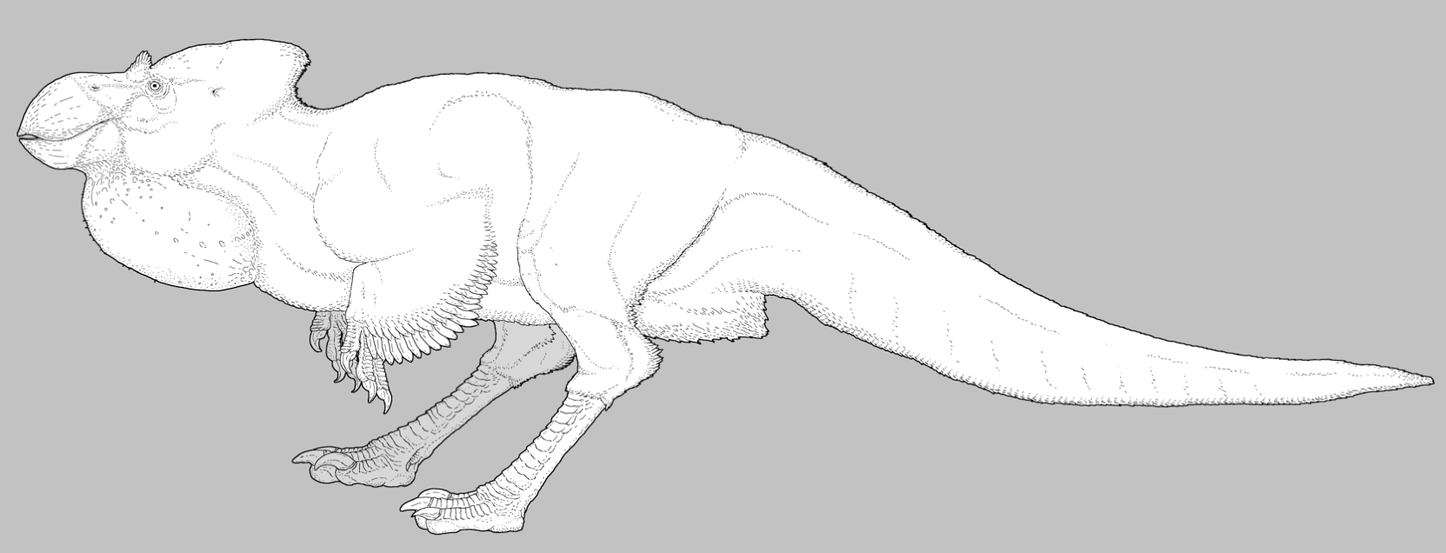
Avisapiens was born out of frustration with the hackneyed presentation of vertically-postured bipedal dinosauroids perhaps popularized by the very human-looking dinosauroid concieved by Dale Russell. The text within the image reads:
Products of primate chauvinism, the current models of erect, humanoid sentient dinosaurs are hopelessly wrong. With a horizontally slung body and the dexterous beak as the prime manipulator, Avisapiens saurotheos is a more feasible sophont, proudly bearing the hallmarks of archosaurian ancestry.
This exciting brand of dinosauroid, which pays due respect to science rather than pure fantastical whimsy, I find much more interesting than the rather trite and overused reptillians to which we are commonly subjected. There is evidence of a burgeoning reaction to the out-dated anthropocentric versions of speculative, post-Cretaceous maniraptora, and Avisapiens represents the best of that effort. I'm particularly fond of the phrase "primate chauvinism".

The artist and creator of A. saurotheos, Nemo Ramjet, has quite an impressive collection of dinosaur and dinosauroid-related work at Deviantart, including some mind-blowingly excellent "dinosauroid cave-art":


Avisapiens is certainly one of the more exciting versions of the dinosauroid I've seen, even if it is only a singular image and an appended paragraph. The image is powerful enough to speak volumes. It's like a quiet, controlled nuetron-bomb igniting within your imagination. The image is subtle; it doesn't force-feed you any information. It lets you do the work.


Here is an another dinosauroid of Ramjet's design from his DA site, refered to as the "Gigantopithecus to the Dinosauroids' H. sapiens". He also notes that, "they walk through dark forests with staffs as long as telephone poles, howling and singing as they go."

Wednesday, November 9, 2011

Bioraptor macloughlini


The Bioraptor was the creation of John C. McLoughlin. It first appeared in the article  'Evolutionary bioparanoia', published in Animal Kingdom magazine back in 1984. I came to this via the excellent Tetrapod Zoology blog by Darren Naish in March of 2008. The image above and the taxonomy therein were taken from Naish, who over the years has dealt with the topic of sophont dinosauroids a number of times, if not always reluctantly as it would seem. 

Naish describes Bioraptor as depicted to the reader by Mclaughlin as

"a swell-headed deinonychosaur that wears jewellery and has invented nuclear weapons, Bioparaptor recalls Russell's dinosauroid in having a short-jawed, big-brained skull and in having lost its pedal sickle-claw, but differs from it in being long-tailed and overall more dinosaur-like."
There seems to be little hope of tracking down the back issue containing this article, so Naish is all we have to go on for the Bioraptor, but I have to admit I was instantly a fan.

Bioraptor was born in 1984, only 2 years after Russell's much more anthropologically-biased version of an advanced maniraptoran, and yet it remains much more true to it's roots. The Bioraptor is somewhat more 'upright' than what we find in the fossil record, but shares the enlarged skull to house the evolved brain. The arms have grown a bit to fashion and wield some crazy kinda weapon, in lieu of the hyper-extended sickle-claw.

Sadly, we are informed that this Bioraptor destroyed itself, and the rest of it's society:
Its nefarious activities not only resulted in a nuclear conflict that caused the end-Cretaceous event, but its domestication of herding cattle-like herbivores (Triceratops and kin) resulted in an impoverished terrestrial fauna where other big animals were rare or absent.
This is, as we will find, a common theme in Dinosauroidia, that is, that the advanced dinosauroids initiated a nuclear apocalypse as the true nature of the K-T extinction event. The idea is fascinating, though not at all meant to be taken literally or seriously. But it should be noted that the rise and fall of a civilization could potentially take place within a few mere thousands of years, and after a duration of 65 million years all evidence of which would long be eviscerated by ice ages, erosion and Father Time's cruel hand.